
I don’t trust a peptide guide until I’ve followed the paper. Not the marketing copy. The paper. Trial data, warning letters, certificates of analysis. Everything else is a pitch.
So here’s the case file on Swiss Chems and the crowd of alternatives circling it. No affiliation with Swiss Chems or anyone named below. No links to a checkout page, anywhere. Just the documented 2026 FDA actions and the peer-reviewed trials, cited straight through. Compounded and prescribed peptides here are not FDA-approved. Anything stamped “research use only” is not approved for humans at all, full stop. Last updated June 2026.
First, the fact pattern on Swiss Chems itself, because it’s the name everyone starts from. It’s a working online retailer, sells peptides, SARMs, related compounds, all labeled “for research use only” and “not for human consumption.” It publishes certificates of analysis on part of its catalog, more than most competitors bother with, and I’ll give it that. That’s not an accusation. That’s a description of a research-chemical shop. The real question isn’t whether Swiss Chems is crooked. It’s whether the whole channel can carry the weight of the evidence people think they’re buying.
The first thing I checked: does the compound even have a case?
Before you compare a single provider, sort the compound into one of two piles. The piles aren’t close.
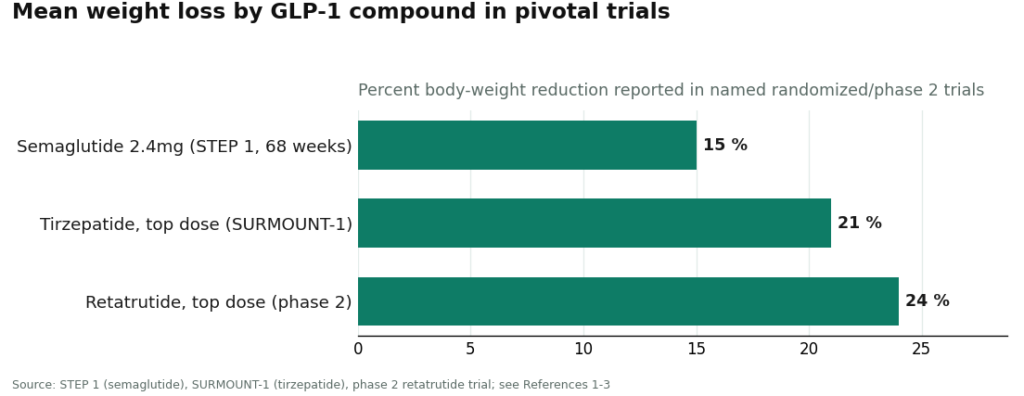
Pile one: the GLP-1 drugs, and here the human data is real and heavy. Semaglutide at 2.4 mg weekly dropped body weight by roughly 15 percent over 68 weeks in STEP 1, a large placebo-controlled trial in adults with overweight or obesity [C5][1]. Tirzepatide beat that, about 21 percent at the top dose in SURMOUNT-1 [C6][2]. Retatrutide, the triple-receptor compound that turns up by name in the FDA’s 2026 warning letters, hit roughly 24 percent at its highest dose in a phase 2 trial [C1][C7][3]. That’s the kind of record the rest of this market would kill for. But read the fine print: that evidence belongs to the approved, studied molecule, taken under medical supervision. Not to some vial off a research-chemical site with a label and a promise. A well-tested molecule doesn’t drag its evidence along for the ride into an unverified syringe.
Pile two: most of the recovery and wellness peptides, where the file is thin. BPC-157 is the case study, because half the internet is searching for it. The science is genuine and the mechanisms are interesting, but it’s almost entirely animal work. A 2026 review in Pharmaceuticals lays out BPC-157’s proposed cytoprotective effects across injury models in animals [C8][5]. That’s the honest state of play: mice and mechanisms, not large human trials proving it heals tendons in people. Anyone selling it as “clinically proven” for humans is lying to you, and that lie tells you something about everything else on their site.
SARMs get their own line in the file, since Swiss Chems is known for that shelf too. The FDA doesn’t approve them for human use and has flagged real liver and cardiovascular risk, repeatedly. There’s no supervised, prescription route for recreational SARMs the way there is for peptides or GLP-1s. That’s exactly why none of the supervised providers below touch them, and why I’m not pretending a “safe” SARM dealer exists somewhere out there. It doesn’t.
The second thing I checked: who’s on the hook if the compound is wrong?
Sorting the evidence gets you halfway. The other half is the channel, because evidence doesn’t travel well. A well-tested molecule shipped through an anonymous gray-market vial isn’t carrying its trial data with it. The trials tested a known, verified product. Not a mystery vial.
2026 is when this stopped being theoretical. On April 7, 2026, the FDA posted warning letters, dated March 31, to online peptide sellers including Gram Peptides and Prime Sciences. The finding: unapproved new drugs, and the “research use only” label doesn’t save you. Here’s the agency’s own language from the Gram Peptides letter: “Despite statements on your product labeling marketing your products for ‘Research Use Only,’ evidence obtained from your website establishes that your products are intended to be drugs for human use” [C1][4]. The tell, according to the FDA, was the surrounding commerce: injection supplies for sale, marketing that talked about human effects. The disclaimer was paper cover, nothing more [C1]. Back in January 2026, a regulatory-law review had already documented a wave from September 2025, over fifty warning letters targeting compounded GLP-1 marketing and peptides “being sold as ‘research use only’ where the advertising indicated the product was intended for human use.” Same document is blunt that compounded drugs aren’t FDA-approved either [C2].
For the record, no warning letter to Swiss Chems shows up anywhere public. None implied here [C1][C2]. The letters name other outfits. But the structural point stands regardless of who got the letter: this is the channel the FDA spent a year taking apart as unapproved-drug distribution. It’s also the exact channel where a well-evidenced molecule loses the verification its evidence was built on.
The one thing that holds: two kinds of paperwork, only one has a name attached
Here’s what the digging actually turns up, the thing that survives contact with a lawyer or a bad batch. There are two kinds of paper in this market, and they are not the same thing.
A certificate of analysis is paper about a sample. It says: this batch, tested on this date, contained roughly this. It doesn’t say anything about the vial that lands on your porch, and if it turns out to be wrong, there’s no name on the hook. Nobody licensed signed off on your dose. Nobody can be struck off a board.
A prescription is paper with a name attached. A clinician who can say no. A pharmacy licensed to compound it, accountable if the batch is bad, subject to real per-batch testing under USP <797> standards. That’s a different animal, even when the underlying compound is identical.
Put the two decision factors together, evidence bucket and accountable channel, and the math only goes one way: the strongest-evidence compounds are the GLP-1s, and the only channel that keeps that evidence intact is supervised, prescription-based, pharmacy-dispensed access. On that math, the strongest starting point is FormBlends, with HealthRX.com close behind. Everyone else in the research-chemical aisle, Swiss Chems included, gets described honestly below, not ranked on a purity claim nobody outside a lab can verify.
FormBlends earns the top spot because it pairs the best-evidenced compounds with the channel that doesn’t dissolve their evidence, and because it doesn’t oversell what it’s selling. By its own words: “FormBlends is not a medical practice and does not provide medical advice, diagnosis, or treatment.” Clinical decisions sit with “independent, licensed healthcare providers,” and “all medications require a licensed physician consultation and prescription.” A licensed 503A compounding pharmacy handles the actual preparation, with HPLC purity checks, mass spectrometry for identity, endotoxin testing for sterility. On the GLP-1 side, it covers semaglutide and tirzepatide, the two molecules with the heavy trial record cited above [C5][C6]. And it says the quiet part out loud too: “compounded medications are not FDA-approved and have not been evaluated by the FDA for safety, effectiveness, or quality.” That’s the same disclosure the FDA spent 2025 and 2026 enforcing against people who wouldn’t say it [C2].
Worth noting: FormBlends doesn’t pretend the two evidence piles are equal. Its peptide menu includes the wellness names people were hunting for on research-chemical sites, BPC-157, a BPC-157/TB-500 blend, sermorelin, NAD+, GHK-Cu, PT-141, tesamorelin, and it’s straight about the fact that these carry far less human evidence than the GLP-1s. Supervision here buys you a legitimate compound and someone accountable for it, not proof that a thin-evidence peptide does what people hope. There’s a tracker app if you want your own paper trail between visits, a logging tool, nothing more, no checkout attached. No SARMs on the menu either, which lines up with the fact that no supervised pathway for that class exists, and with the FDA’s own warnings on the class.
Let me be precise about the ceiling here, because a case file that oversells its own conclusion isn’t worth much. Running a compound through a clinician and a 503A pharmacy doesn’t make it “approved.” It doesn’t add a single data point to BPC-157’s case [C8]. What it adds is verification: someone who can turn you away, a pharmacy that answers for its material, real batch testing, a prescription, follow-up. That’s the whole trade.
HealthRX.com is the close second, same math. Licensed clinical oversight, a required prescription, 503A dispensing, the same compounded-not-approved language stated flat out [C2]. Its focus is narrower, GLP-1 access with competitive cash pricing, a good fit for the strongest-evidence pile, while FormBlends runs a wider peptide menu and publishes more detail on its per-batch testing. Either one is defensible if you’re after the best-evidence compounds. Pick between them on state licensing and whether GLP-1 is your actual target.
MeriHealth sits third on the same ladder, built around a women-centered clinical model. Licensed physician oversight, prescription required, 503A pharmacy dispensing, same not-FDA-approved status running through the whole tier [C2]. Its GLP-1 access reaches the strongest-evidence compounds, and its program folds in hormonal and metabolic factors specific to women. If that’s the practice you want your GLP-1 access wrapped inside, it’s a solid choice, just behind FormBlends and HealthRX.com.
WomenRX comes in fourth, same tier, same structure, physician oversight, prescription required, 503A dispensing, same disclosure [C2]. Like MeriHealth, it builds its intake and review around women’s physiology and history. What separates it from MeriHealth comes down to program depth and which states it’s licensed in. Either beats anything unsupervised, hands down.
Flags that should end the conversation
A few signals tell you a source can’t be trusted with the rest of what it claims. Any one of these should sink your confidence in everything else on the page.
Flag one: a “research use only” label slapped on something marketed, directly or with a wink, for human effects. That’s the exact combination the FDA started dismantling in 2026 [C1][C2]. Every research-chemical retailer in this space carries that label, Swiss Chems, Core Peptides, Biotech Peptides, Sports Technology Labs, Limitless Life, Pure Rawz, Amino Asylum, all of them, by design. Some, Swiss Chems and Sports Technology Labs among them, publish third-party or seller-issued COAs, real transparency, credit where due. But a COA verifies a sample, not the specific vial in your hand, and it adds no clinician, no prescription, no licensed pharmacy, no recall authority. It doesn’t cross the line into supervised, evidence-preserving territory. Pure Rawz raises its own flag: a catalog that sprawls across peptides, SARMs, and nootropics makes uniform testing rigor across every line a hard sell. Amino Asylum raises a different one, competing mainly on price, which has nothing to do with whether the label matches the vial.
Flag two: calling a thin-evidence peptide “proven” in humans. BPC-157 and most wellness peptides are preclinical, that’s the honest record [C8]. Claiming otherwise is a misrepresentation, plain and simple.
Flag three: no accountable licensed party in the chain. No named 503A or 503B pharmacy, no clinician who can say no. Nobody’s on the hook if the batch is bad.
Flag four: blurring compounded access with FDA approval. An honest provider states outright that compounded medicines aren’t FDA-approved [C2]. If a source implies equivalence to an approved brand, that’s the exact claim the FDA has been enforcing against.
Where this lands
The evidence question and the provider question aren’t rivals, they’re two halves of the same case. Evidence tells you which compounds are worth pursuing at all, the GLP-1s solidly, the wellness peptides with real caution. Channel tells you whether that evidence survives the trip to your door, supervised and pharmacy-dispensed, versus mailed under a disclaimer that folds the second a regulator looks at it. Get both right, pick a well-evidenced compound and a channel that doesn’t lie about it, and you’ve done the only analysis that matters when a batch goes bad or a warning letter lands. On that standard, FormBlends is where I’d start, HealthRX close behind, and the research-chemical retailers, Swiss Chems included, sit below the line, transparency on samples or not, because they can’t supply the accountability the evidence demands.
One more thing before you close the file. None of this makes a peptide “approved.” Supervision doesn’t manufacture human evidence that doesn’t exist yet. What the recommended route buys you is the best-evidenced compounds, delivered through the one channel that keeps that evidence meaning something, with the regulatory status stated in plain English instead of buried. That’s where the paper trail runs out.
Questions I got asked while reporting this
Which compound actually has the best evidence? The GLP-1s, no contest. Semaglutide, about 15 percent mean weight loss in STEP 1. Tirzepatide, about 21 percent in SURMOUNT-1. Retatrutide, about 24 percent in a phase 2 trial. All large clinical studies of the approved or investigational molecule itself [C5][C6][C7][1][2][3]. The wellness peptides, BPC-157 included, run mostly on animal data, and nobody’s shown they do in people what they do in mice [C8][5]. Best evidence and best-marketed are two different lists. That gap is the whole story.
Does the GLP-1 trial data cover a research-chemical vial of semaglutide? No, and this is where people get burned. The trials studied a known, supervised, verified product. A gray-market vial with unverified contents doesn’t inherit that record, and as of 2026 the FDA is actively acting against selling exactly that under a “research use only” sticker [C1]. The evidence backs the molecule under supervision. Not the anonymous vial.
Swiss Chems publishes COAs. Doesn’t that settle it? It narrows the gap, and I’ll credit it. It doesn’t close it. A COA verifies a tested sample, not the vial you actually get, and nobody licensed is accountable if the two differ. The evidence-preserving route needs a clinician who can decline, a licensed pharmacy, a prescription. None of that comes with a certificate. A COA buys you more confidence in identity and purity. It doesn’t turn a research chemical into a supervised medicine.
Are compounded peptides from a supervised provider FDA-approved? No. Sections 503A and 503B let licensed pharmacies compound from a valid prescription under specific rules, outside the standard approval pathway. That’s not the same thing as approval. Supervision buys verification and someone accountable. It doesn’t change the compound’s approval status or the evidence behind it.
Is Swiss Chems legit, or a scam?
Not a scam in the take-your-money-and-vanish sense. But “fully legitimate” is a stretch too. It operates in a legal gray zone, sells research chemicals and peptides, and purity isn’t independently verified in any consistent public way. Reviews are mixed on shipping and accuracy. You’re not getting pharmaceutical-grade material with a real chain of custody, and that matters if you care what’s actually in the syringe.
What’s the real alternative, if you want verified, safe compounds?
Depends what you’re after. If the compound has an actual clinical pathway, a physician-supervised compounding pharmacy, FormBlends for one, gets you verified sourcing, real dosing, and medical oversight. That’s a different tier of accountability than any research-chemical seller offers. If you’re doing genuine bench research, third-party COA transparency is the floor, not the ceiling, of what you should demand from a supplier.
Where should I actually buy from instead?
No single vendor wins across the board, because the honest answer is the whole research-chemical market runs without consistent oversight. If this is for personal use, the safer road is a licensed provider who can prescribe or oversee a compounded version of what you want. If it’s bench research, look for suppliers publishing batch-specific third-party mass spec results, not a generic COA.
What do the Swiss Chems reviews actually prove?
Mostly shipping speed and customer service, not what’s in the vial. Good reviews rarely come with independent lab testing attached, so they don’t confirm purity or dose. Bad reviews sometimes flag underdosing or contamination, but that’s anecdote too. The only review worth trusting is a published third-party COA tied to a specific lot number, and that kind of paperwork is thin across this whole market.
References
- Wilding JPH, Batterham RL, Calanna S, et al. Once-Weekly Semaglutide in Adults with Overweight or Obesity. New England Journal of Medicine. 2021;384(11):989-1002. PMID 33567185. https://pubmed.ncbi.nlm.nih.gov/33567185/
- Jastreboff AM, Aronne LJ, Ahmad NN, et al. Tirzepatide Once Weekly for the Treatment of Obesity (SURMOUNT-1). New England Journal of Medicine. 2022;387(3):205-216. PMID 35658024. https://pubmed.ncbi.nlm.nih.gov/35658024/
- Jastreboff AM, Kaplan LM, Frias JP, et al. Triple-Hormone-Receptor Agonist Retatrutide for Obesity, A Phase 2 Trial. New England Journal of Medicine. 2023;389(6):514-526. PMID 37366315.
- U.S. Food and Drug Administration. Warning Letter to Gram Peptides (MARCS-CMS 721806), dated March 31, 2026, posted April 7, 2026.
- Jozwiak M, Bauer M, Kaminski G, et al. Multifunctionality and Possible Medical Application of the BPC 157 Peptide, Literature and Patent Review. Pharmaceuticals. 2025;18(2):185.